Home › Services › Rooftop & balcony rain drain
Rain on the Roof, Water on Your Ceiling: Rooftop Drains, Downpipes and Balcony Rain Lines
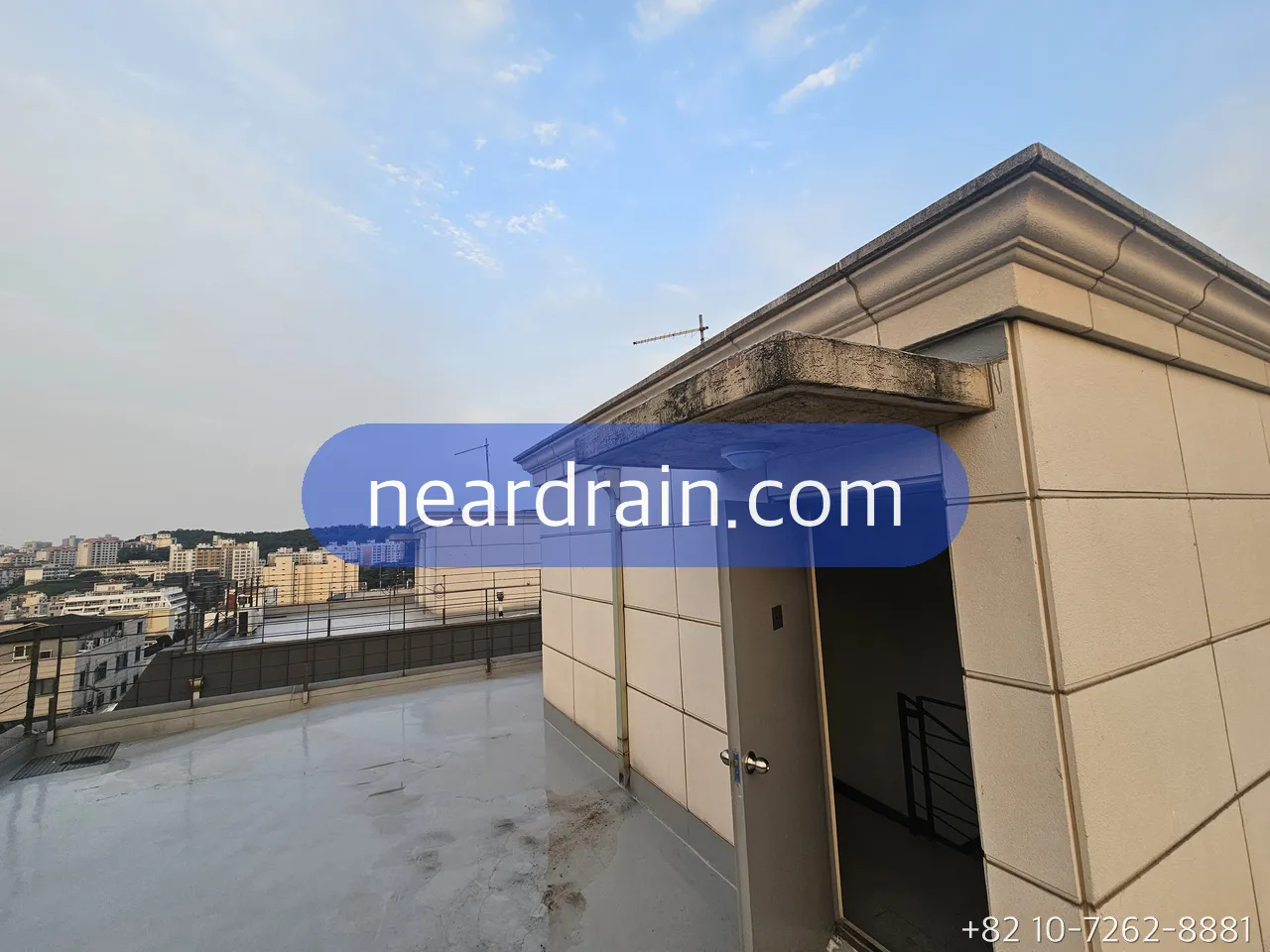
A rooftop drain clogged with leaves (옥상 배수구 막힘) does not announce itself until the first heavy rain, and by then the water has found the unit below. This page is for the rooftop-unit renter, the top-floor villa owner and the apartment balcony tenant whose rain drain (우수관) has stopped taking water — what the rain line actually is, why your bathroom plumber's cable never reaches it, and how we clear it from the roof down.
Bathroom floor drain or shower drain backing up? That is the waste line, a different pipe — see blocked floor & shower drain. Stain on a ceiling that grows without rain? Start at water leak detection.
Who calls about the rain line
- Rooftop-unit (옥탑) renters in Itaewon and HBC — the terrace is your front yard, the drain is in the corner under a planter, and nobody has lifted the grate since the last tenant left
- Top-floor villa owners across Yeonnam, Seorae and Hannam — you own the roof, the unit below you is complaining, and the management "office" is you
- Apartment balcony (베란다) tenants in Ichon and Gangnam complexes — the balcony floor drain joins a rain riser shared by every floor, and yours is the one that overflows when the neighbor above hoses the balcony
- Ground-floor shop and cafe tenants whose alley gully outside the door fills with silt and sends rainwater under the threshold
- Building managers before monsoon — one visit to check every roof drain and gully is cheaper than one ceiling repair in July
The rain line is a separate pipe — roof drain, downpipe, ground gully
Korean buildings run two drainage systems that never meet inside the building. The waste line takes toilets, sinks and floor drains to the sewer through traps and a vented stack. The rain line takes the roof and balcony water through a roof drain (루프드레인), down a downpipe (우수 입상관 or 홈통) on the outside or in a shaft, and out to a ground-level gully (우수받이) that joins the street storm drain. It has no traps, no vents, and no cleanouts inside your bathroom — which is why the cable that cleared your shower drain last year cannot be pushed into it from anywhere indoors. The rain line is worked from two ends: the roof or balcony drain at the top, and the gully or the downpipe's bottom cleanout at the bottom.
What blocks it, by season
October–November: leaves
Ginkgo and zelkova leaves off the street trees land on every flat roof in Yongsan and Mapo and slide to the drain. Wet leaves mat over the basket; the ones that get through pack the first bend. The autumn blockage you do not notice until the winter rain.
March–May: grit and pollen paste
Yellow dust and pine pollen settle on the roof, then the first spring rain turns them into a paste that coats the drain bowl and narrows the downpipe. Fine enough to pass any leaf guard.
June–August: butts, nests and monsoon volume
Cigarette butts from the rooftop table, a pigeon nest in the downpipe hood, and then 50 mm of rain in an hour. A drain that was half-open all spring becomes a pond in twenty minutes of jangma.
December–February: ice at the outlet
The bottom elbow where the downpipe exits the wall freezes when it holds a little standing water. Snowmelt on the roof then has nowhere to go and refreezes on the terrace. See our frozen pipes guide for what not to do to a frozen downpipe.
The overflow path — and how to tell rain water from a pipe leak
Water on a blocked terrace rises until it clears the lowest edge: the door threshold of the rooftop unit, the flashing where the parapet meets the floor, or a crack in the membrane. From there it runs inside the slab and shows up as a ceiling stain in the unit below — usually near an outside wall, usually within a day of heavy rain, usually dry again a week later. A supply-pipe leak does the opposite: the stain grows in dry weather, it tracks a pipe route rather than a wall edge, and the water meter moves with every tap closed. We check those three discriminators before anything else, because the cheapest fix is a cleared drain and the most expensive is opening a ceiling for a leak that was never there.
When it is waterproofing, we say so. If the drain flows and the terrace still leaks into the unit below, the membrane or the parapet joint is the problem. Waterproofing (방수) is a separate trade with its own materials and warranty terms; we do not do it, and we will not clear a drain twice to avoid telling you that.
How we clear it, in order
1 · Basket and grate first
Lift the grate, empty the basket, scoop the bowl. A surprising share of rooftop calls end here, and we tell you if yours does before quoting anything further.
2 · Hand-fed cable from the roof
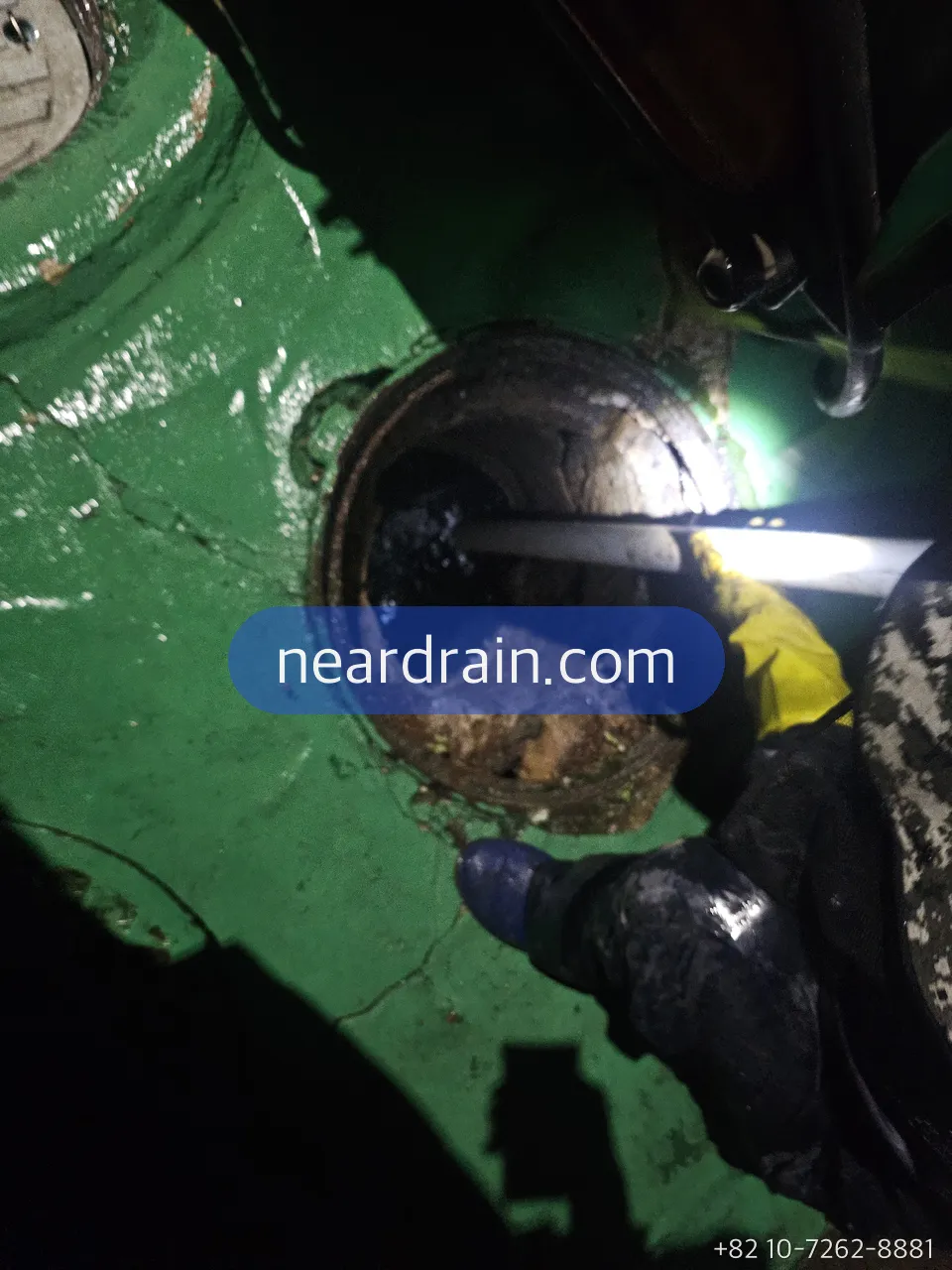
A small cable goes down the roof drain to the first bend and the top of the downpipe — the two places leaves pack. We work by feel and by the water test, not by force, because a rain downpipe is thinner-walled than a sewer line.
3 · Jet the downpipe from the bottom cleanout
If the run to the ground gully is still slow, we open the bottom cleanout or the gully and jet upward. Pollen paste and grit come out at the bottom, into a bucket, not back onto your terrace.
4 · Water test with a hose
A full hose into the roof drain for a few minutes, watched from the gully below. Flowing free at the bottom is the finish line; you see it and we photograph it.
Balcony rain drains in apartments: the shared riser and the management office's part
In a complex the balcony floor drain on every floor joins one rain riser. That riser is common property: the management office (관리사무소) is responsible for it, and a tenant cannot have it jetted without the office's sign-off. What the tenant controls is the section inside the balcony — the drain bowl, the trap if one was added, and the short stub to the riser. Two things we find constantly in Ichon and Gangnam balconies: a washing machine discharging into the rain drain (it should go to the waste line; the lint and detergent film block a rain stub within a year), and a balcony that was enclosed (확장) with the drain tiled over and forgotten. If your balcony drain overflows only when an upstairs neighbor uses water, the riser is the problem and the office books it. If it overflows only in rain, the stub or the roof drain above is the problem and we can start with you. We write the office a short note in Korean either way.
Before monsoon: a 10-minute check you can do yourself
- Lift every roof drain grate and empty the basket — leaves, a tennis ball, a plant pot saucer, whatever is there
- Pour a full bucket into each drain; it should vanish in seconds without gurgling
- Walk the downpipe to the ground and look at the bottom elbow and the gully — silt over the gully grate means the box below is full
- Look at the parapet joints and the door threshold of the rooftop unit for old water marks: that is where last year's overflow went
- Check that nothing on the terrace — planters, decking, an air-conditioner outdoor unit — is sitting on the drain or blocking the path to it
A pre-season visit from us covers the same list with the cable and the hose test added, every drain on the roof, the gullies at ground level, and a replacement basket where one is missing. Building owners book it in May; rooftop tenants usually book it after the first June downpour has already proved the point.
Price
Fixed quote on site · VAT 10% separate
Depends on roof access, how many drains, and whether the downpipe needs jetting from the bottom cleanout. Tenant or building booking is agreed before the visit.
- Fixed quote before work starts — you agree to the number first. If the scope turns out to be different mid-job, we stop and explain before anything continues.
- Card payment accepted. Cash receipt or corporate tax invoice (세금계산서) issued on request.
- VAT 10% is quoted separately, and we tell you the VAT-included total before starting.
What decides the figure
- Roof access — an internal stair and a door is one thing; a ladder from the top-floor balcony and hauling the jetting hose up the outside of the building is another
- Number of drains — one terrace drain, or every drain on a building's roof plus the gullies below
- Whether the downpipe needs jetting — a basket-and-bend job is quick; a downpipe packed with pollen paste from roof to gully is jetting from the bottom cleanout
- Tenant vs building booking — who pays is agreed before the visit so the figure is not argued afterward on the terrace
Questions rooftop tenants and owners ask
The terrace floods but the drain looks clear — where is the blockage?
Below the grate. A roof drain has a basket, then a bowl, then a bend into the downpipe, and leaves that pass the grate settle at that first bend or at the bottom elbow where the pipe turns out through the wall. A clear grate with standing water around it almost always means the bend is packed. Pour a bucket of water in: if it sits, the blockage is within the first metre; if it drains slowly and then gurgles, it is lower in the downpipe and we clear it from the bottom cleanout.
My landlord says the rooftop drain is "common area". Who books and pays?
In a villa with an 옥탑 unit the roof drain usually is common area, and the building owner is the one who books and pays for it — but you are the one standing in the water, so in practice the tenant sends the photos and the landlord confirms the booking by text. We are happy to take the booking from either side as long as the payer is clear before the visit. Send us the photos and your landlord's number; we can explain the job in Korean directly so you are not translating a drain pipe over the phone.
Water came through my ceiling during the typhoon. Is this a plumbing job or a waterproofing job?
Both are possible and we tell you which on site. If the terrace above you had standing water because the drain was blocked, water rose over the threshold or the flashing and found its way down — clear the drain and the ceiling dries. If the drain was flowing and the ceiling still leaked, the roof membrane, a crack, or the parapet joint is letting water in, and that is waterproofing (방수), a separate trade we do not do. We check the drain first because it is cheaper and faster to rule out, and we say plainly when it is not the drain.
Can you install a leaf guard so it stops happening?
We fit a dome-type leaf strainer over the roof drain if the bowl accepts one, and we replace a missing or rusted basket — both are small items we carry. A guard cuts the autumn blockages but it does not replace the ten-minute check before monsoon: pollen paste and grit still pass through, and a guard that is itself buried in leaves is a blocked drain with extra steps.
Does this include the yard drain (마당 배수구) at ground level?
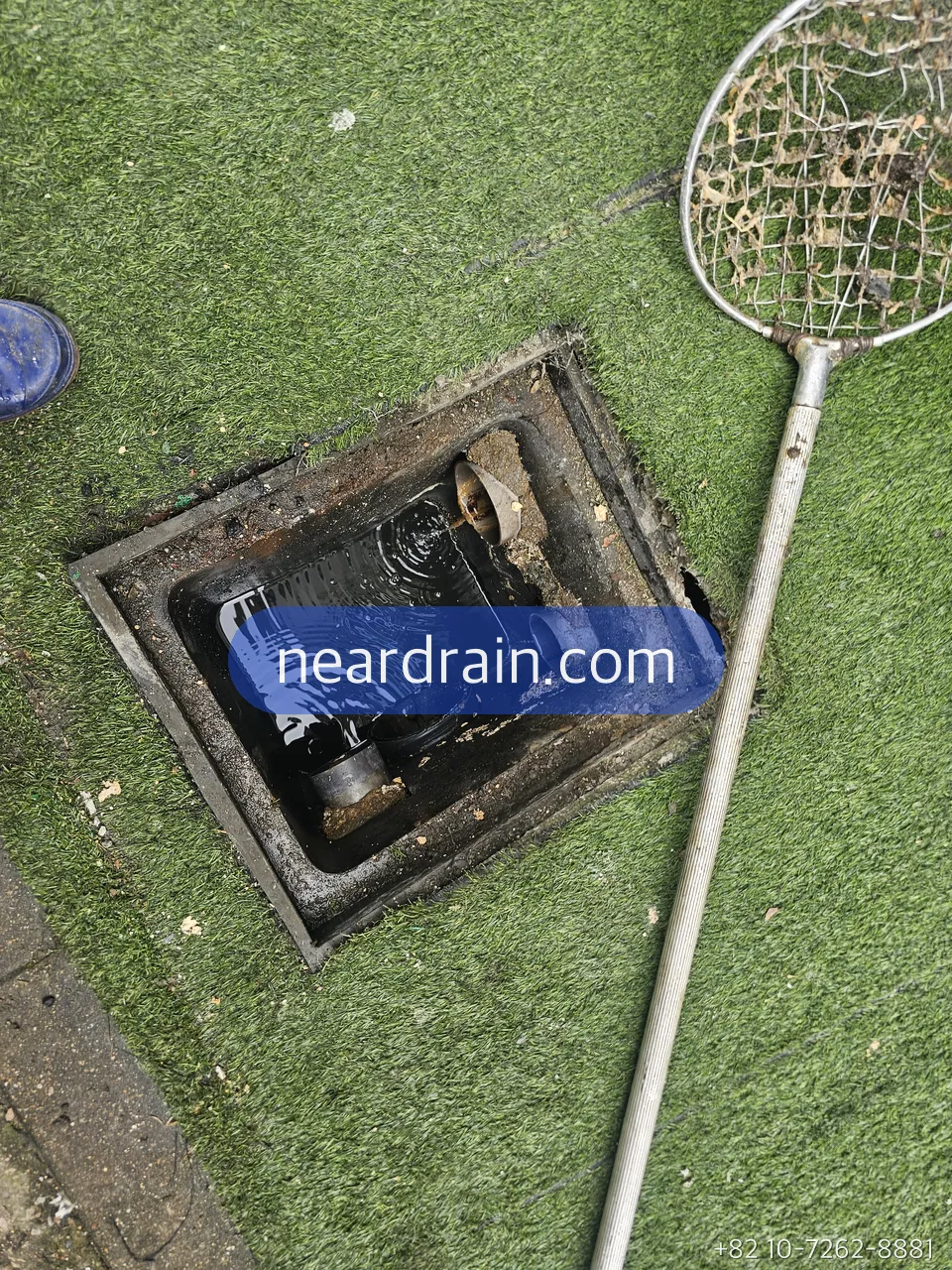
Yes. The rain line ends at a ground-level gully (우수받이) — the square or round box in the yard, the parking pad or the alley outside the gate — and that box fills with silt, cigarette butts and roots. If the rooftop drain is clear but the water still backs up, the gully at the bottom is the next thing we open. Clearing it is part of the same visit and quoted with it.
Related reading
Who pays for plumbing repairs in Korea — landlord or tenant?
Frozen pipes in Korean winters: prevention and what to do
Moving into a Korean apartment: 10-minute plumbing checklist
English by text (SMS) works best. Phone calls are fine in Korean or Japanese. Rooftop units in Itaewon and HBC: our Itaewon page covers terrace access and parking.
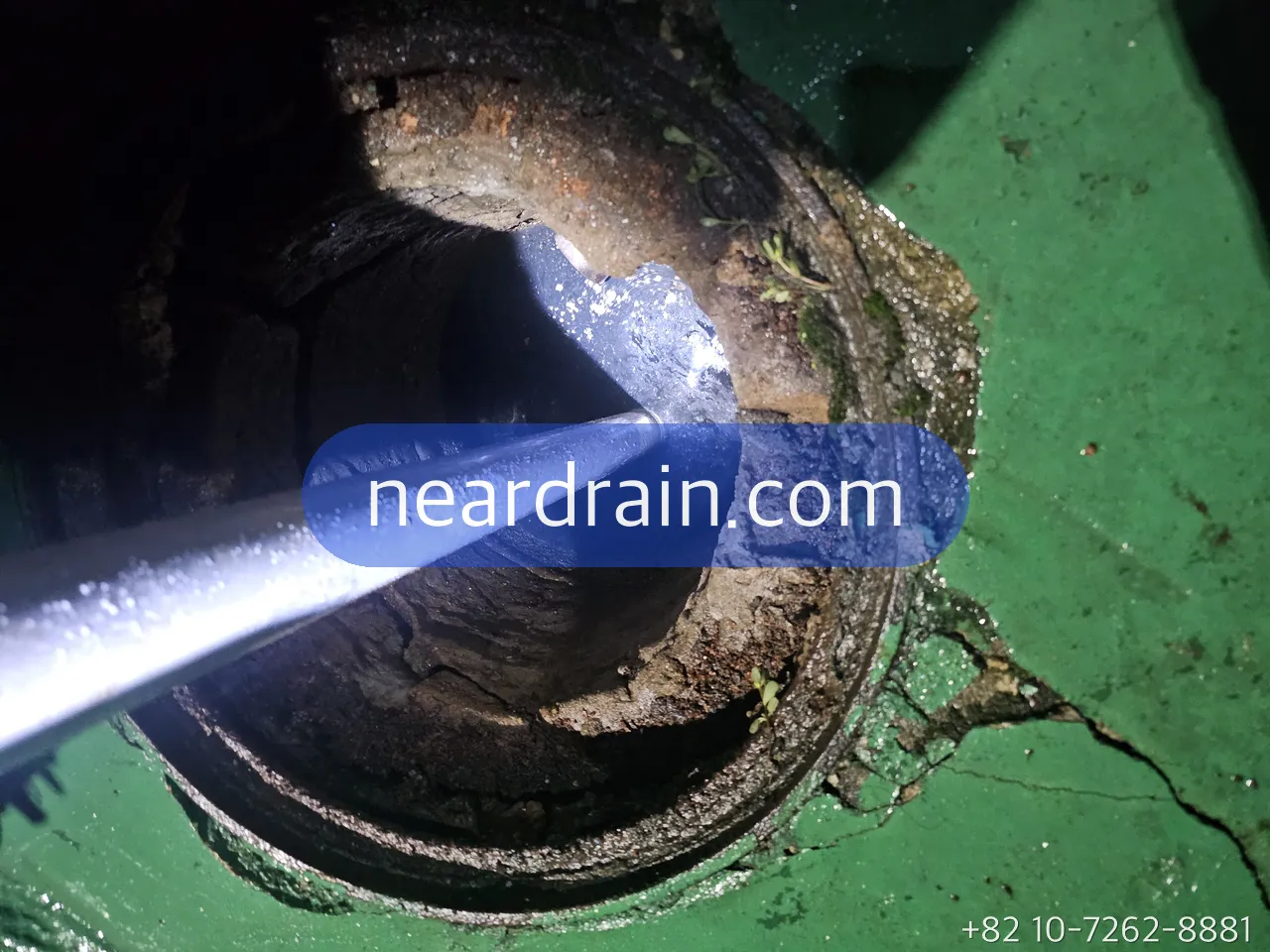
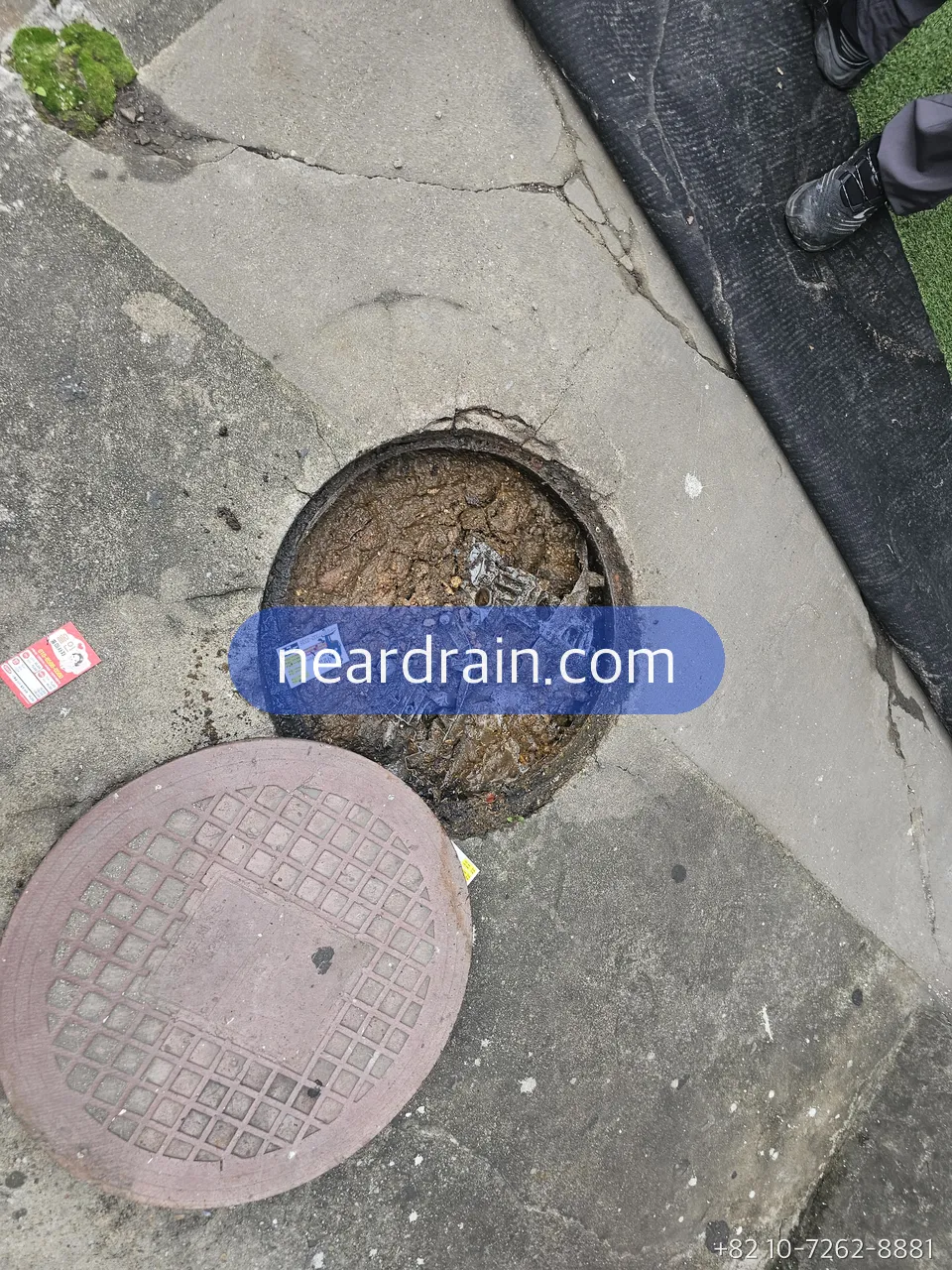
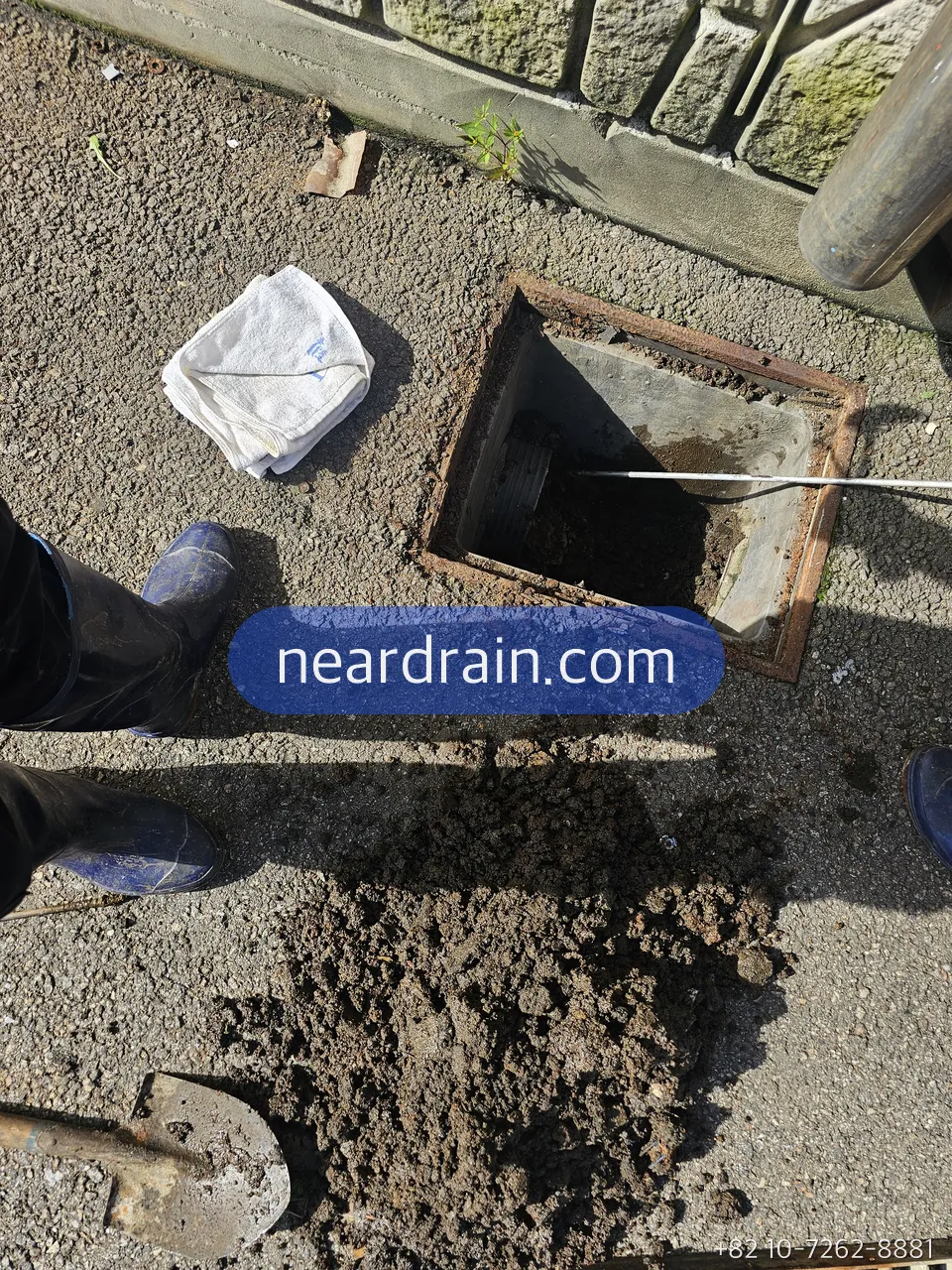
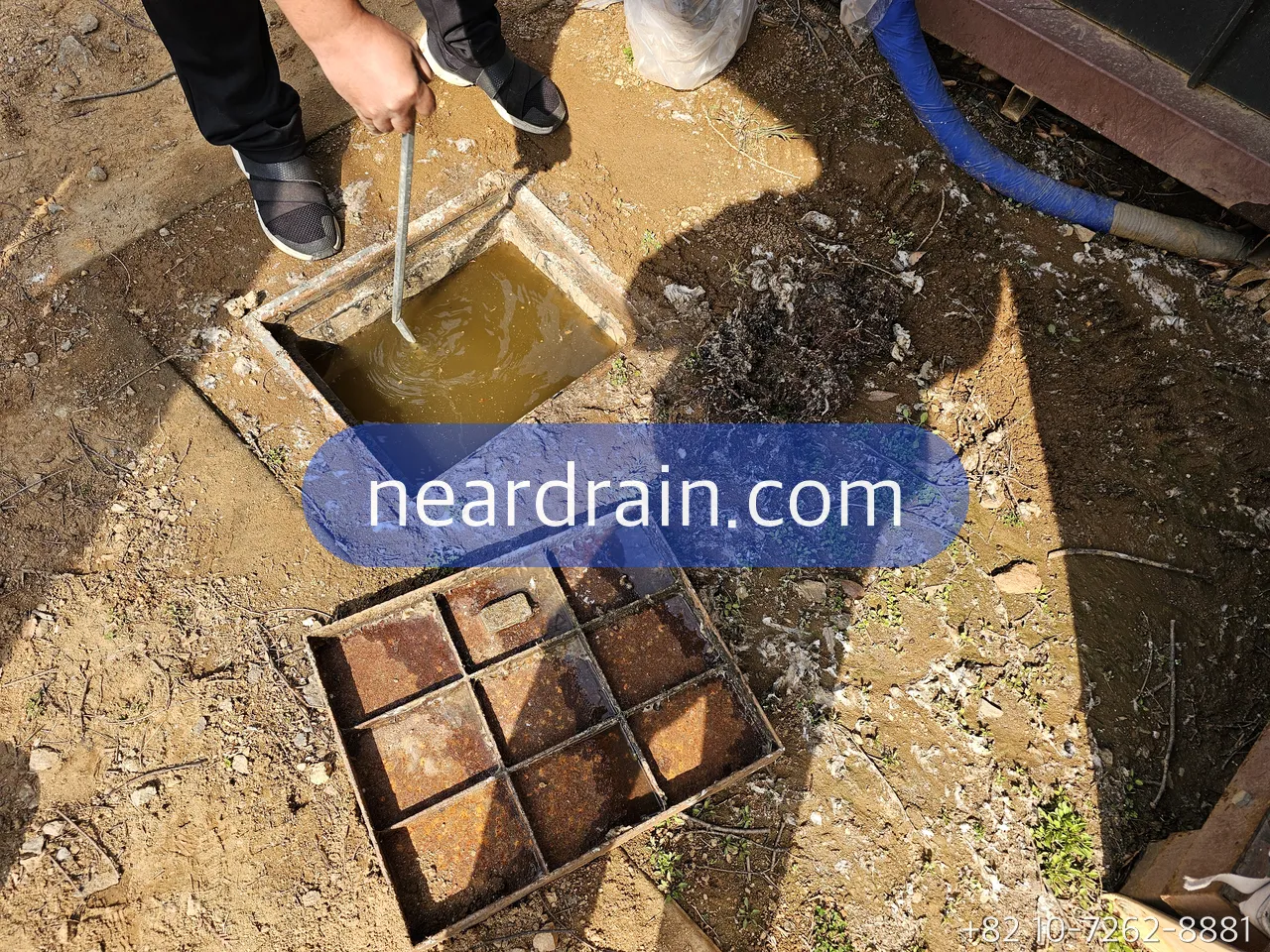
Rain-line jobs from our own sites
No stock photos on this site — every image below was taken by our crew on a real call.